



TOURNAMENT SAVAGERY BY NICK PETRANGELO & DANIEL DVORESS
THE 25-HOUR MASTERCLASS THAT WILL TRANSFORM YOUR GAME

Tournament Savagery is the most complete ICM course on the market. Nick Petrangelo and Daniel Dvoress take you through every stage of the tournament in sequence, from chip EV in the early levels, through the bubble, down to three-handed at the final table: 43 videos, 25 hours, and 39 drills that turn what you watch into what you execute. The best MTT players in the world have bought this course. It exists for one outcome: to make the final table the beginning, not the destination.
INCLUDES 1 MONTH PRO PLAN FREE

YOU WILL LEARN
Every Stage, From Chip EV to Full ICM
The course mirrors a tournament: chip EV preflop first, then rising ICM pressure through the bubble, then the postflop decisions that actually close it out. You learn how risk premiums and bubble factors reshape your ranges and sizings at every stage — and where the real edges are, preflop and post.
YOU WILL LEARN
Bubble ICM Pressure and More Deep Runs
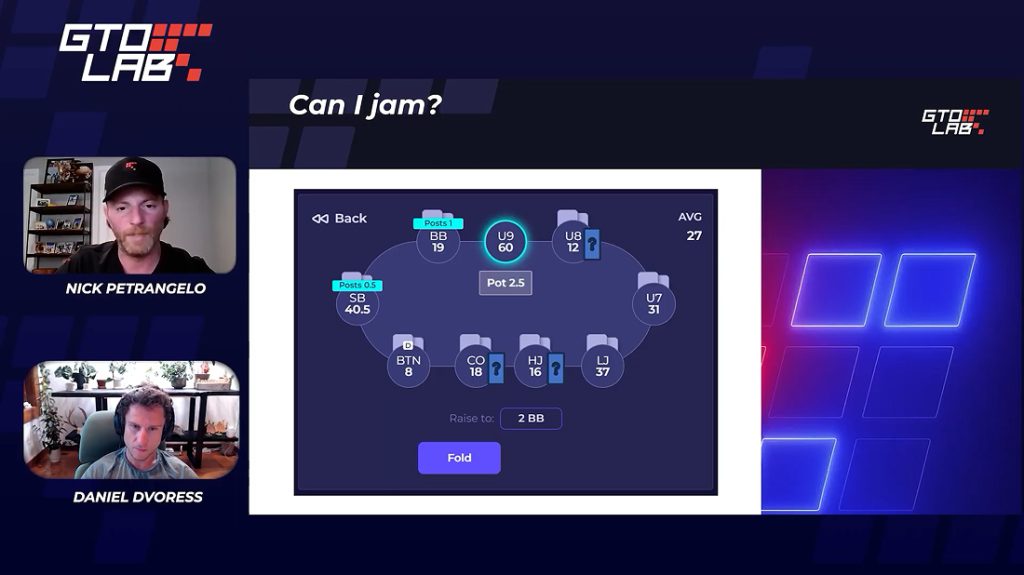
ICM pressure peaks on the bubble, often above the final table. Daniel shows how your stack relative to the average, not your blind count, drives your risk premium, then gives you the ranges to apply maximum pressure as a big stack, stay dangerous as a mid stack, and pick the right gambles short.
YOU WILL LEARN
Final Table Strategy and Closing Out Tournaments
The deepest part of the course: over 10 hours on final tables, preflop and postflop, from 9 players down to 2. Short, mid, and big stack play at every table size, the five chip-leader mistakes that leak the most EV, and hand reviews from Triton and WSOP final tables against Fedor, Ponakovs, Naza, and Dan Smith.
HOW IT WORKS
The videos
- Concept introduction. The highest-leverage spots at that stage of the tournament and the mechanics that govern them.
- Solver breakdown. What GTO play looks like, with exact frequencies from the GTO LAB sims and PIO.
- Population exploits. Node locks swap the equilibrium opponent for the frequencies real fields play, and show you where the money is.
- Hand review from Triton and WSOP final tables: how humans play the spot versus what the solver says.
HOW IT WORKS
The Drills
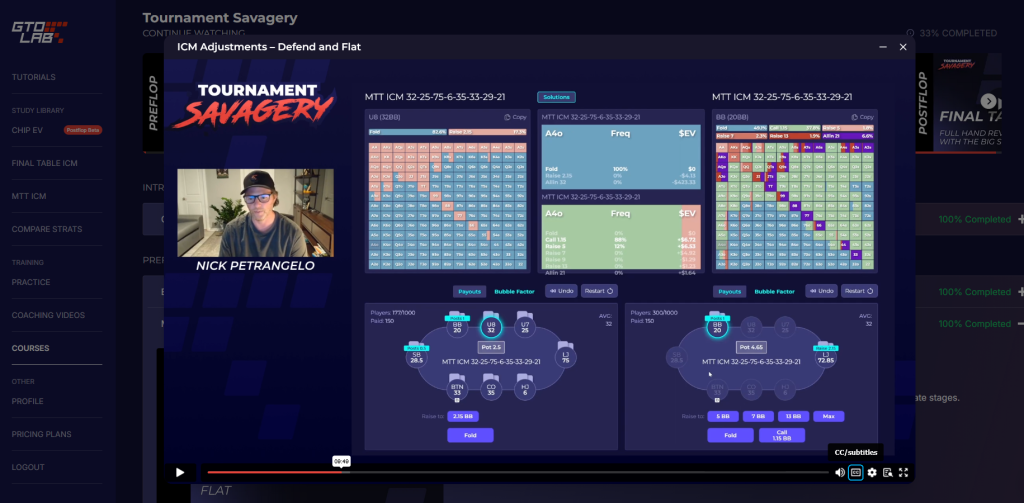
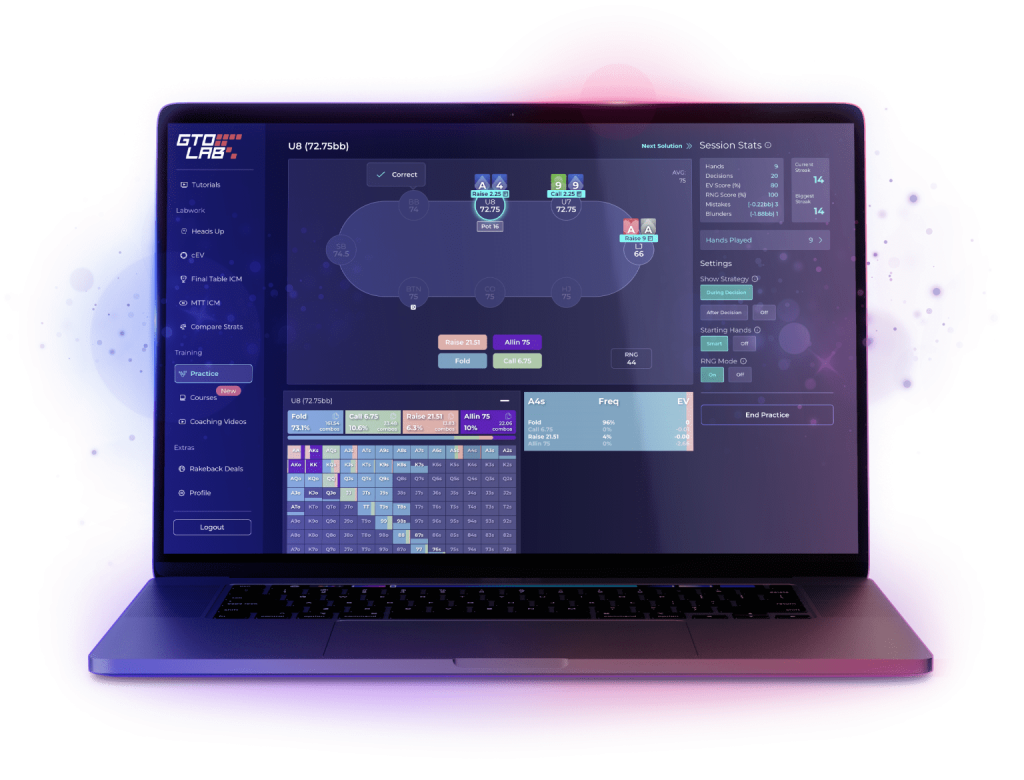
The 43 videos carry 20+ attached drills, and the drills separate Tournament Savagery from every other MTT course. Each one loads that exact spot in the range trainer: same stacks, same stage, same decision. Watching builds understanding; reps make it automatic. As Nick says: you’ve got to drill these spots.
HOW IT WORKS
JOIN THE DISCUSSION
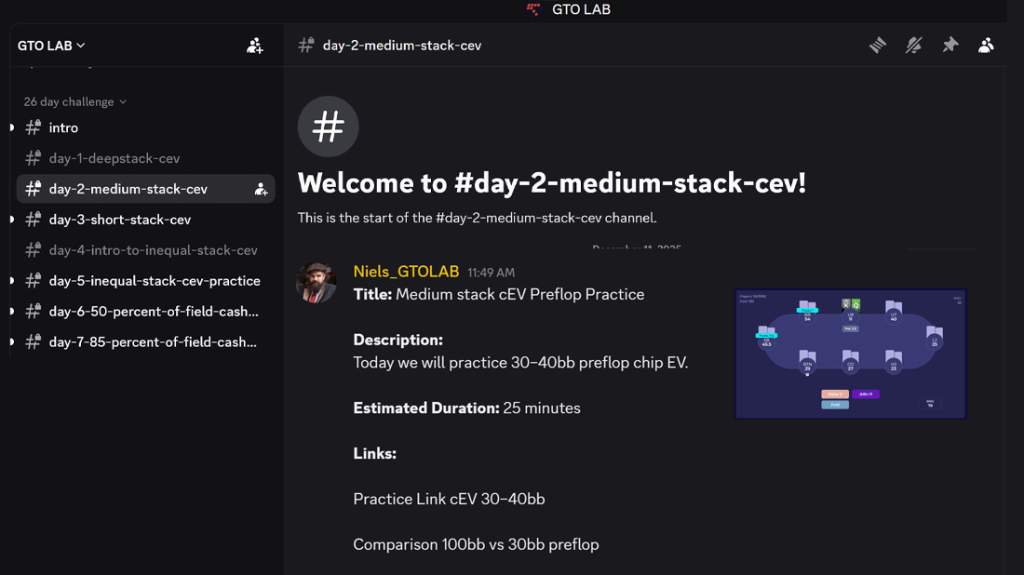
When you buy Tournament Savagery you get access to a private Discord channel where you can discuss the videos and drills and share learnings. Send your Discord handle to support@gtolab.com and we will add you.
WHO IS IT FOR?
PROS & REGS
- MTT professionals and serious grinders who know the theory and need the layer above it: where real fields deviate from GTO and how to profit.
- Regs who have plateaued on solver study and need the mechanics behind the outputs to adjust in spots no chart covers.
- Players who keep cashing and keep missing the top three. The money sits in first through third.
This is an expert course. If you are new to ICM, start with the 26-Day Training Plan instead.

MEET YOUR INSTRUCTORS


Nick Petrangelo
Nick Petrangelo is one of the greatest tournament players of all time. His ability to perform under pressure has made him a top competitor in the world’s biggest buy-ins. Beyond his success on the felt, he has created MTT courses and coached WSOP Main Event finalists, helping them prepare for their final tables. He has also worked with poker influencers like Rampage, Frankie C, and Brad Owen, bridging deep poker theory with practical application.
Now, in this masterclass, he joins Daniel Dvoress, his long-time study partner, to break down tournament strategy in more depth than ever before.
-
Over $41.9 Million in Live Tournament Earnings
-
Two WSOP Bracelets
-
Won numerous WCOOP, PGT, Wynn, Triton, EPT & WPT events

Daniel Dvoress
Daniel Dvoress is one of the most well-studied tournament players in poker, known for his analytical approach and deep theoretical understanding. A former Run It Once coach, he played a key role in shaping tournament strategy before shifting his focus to competing in high rollers.
Now, after years away from coaching, he returns with GTO LAB, bringing his expertise to a new generation of tournament players.
-
Over $54 Million in Live Tournament Earnings
-
WSOP Online Millionaire Maker Bracelet Winner
-
Multiple High Roller Titles at Triton, EPT and PGT
Tournament Savagery Course CHAPTERS
INTRO
Course Introduction - 1 Video
Nick and Daniel walk through the four sections of the course and how the preflop track mirrors a tournament: chip EV first, then rising ICM pressure to the bubble, then the climb back up to the final table and three-handed play.
PREFLOP
Early Stages - 3 Videos
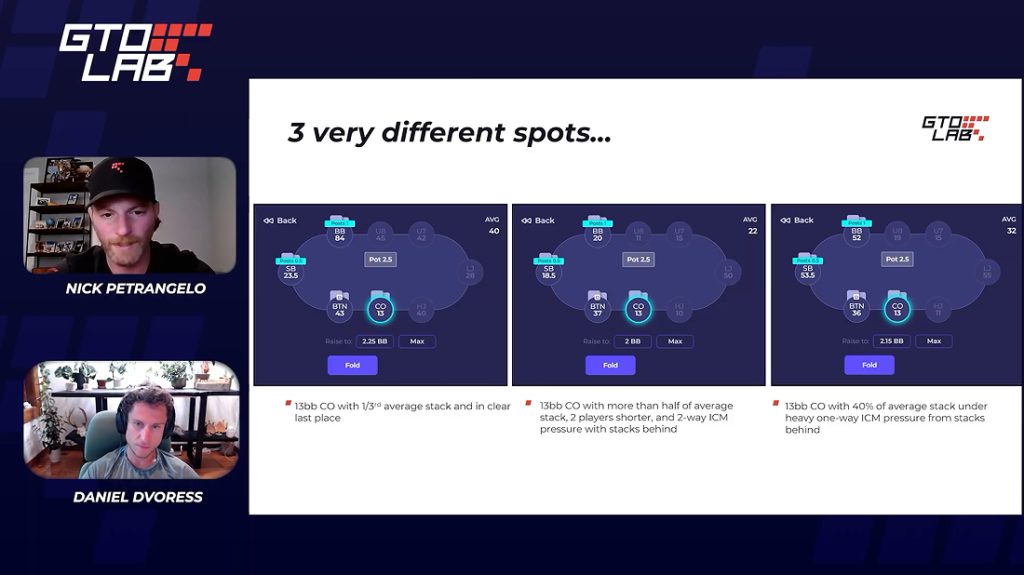
Daniel covers the differences between chip EV and ICM, the limits of current models, and re-entry versus freezeout dynamics. Then the sizing mechanics: why min-raising takes over below 30bb, where shoves enter position by position from 20bb down, and how to build 3-bets as a percentage of a pot-sized raise instead of a memorized multiple.
Mid-Stages - 50-30% of the field left - 2 Videos
Nick compares chip EV baselines against 300-left and 177-left sims and tells you which adjustments to take and which to ignore. The solver wants you defending 37% instead of 60% with 150 players between you and the money; Nick calls that fake, shows you why, and shows you how to counter opponents who adopt it.
Later Stages: ICM - 1 Video
Daniel builds risk premiums and bubble factors from first principles: what they measure, how to compute them at the table, and the cases where they mislead you, starting with deep stacks.
Approaching the Bubble - 2 Videos
Risk premium grows along a continuum; there is no switch to flip when the bubble appears. Daniel shows why your stack relative to the average drives everything, including the counterintuitive spots where a 10bb stack calls off wider than a 6bb stack. Quick-fire hand reviews from a $21K buy-in, 17 players off the money, put the concepts under real conditions.
The Bubble - 2 Videos
Stone bubble play by stack size. Big stack pressure, short stack survival, and the frequency-sensitivity of re-steals.
Post-bubble - 2 Videos
The bubble bursting is the biggest single ICM shift in the tournament. Risk premiums collapse below 5% in large fields, yet much of the field keeps folding like the bubble never burst. Daniel names the leaks (3-bets for a third of a stack, folds with 84% equity) and shows you how to attack opponents stuck in ICM mode.
Approaching the Final Table - 2 Videos
With 16 left, your risk premiums against every covering stack converge within a percent, which changes who you can fight. Daniel reframes stacks as a share of the prize pool, gives you a gambling threshold in multiples of the average stack, and reviews hands from the Triton $25K WPT Global Slam two tables out.
Final Table: 6-9 players left - 3 Videos
Short stack, mid stack, and chip leader each get a dedicated video. When in doubt, don’t jam: raising forces your opponents into decisions they get wrong, while shove call-offs are too clean to misplay. The chip-leader video names the five most expensive big-stack mistakes, starting with treating “covered” as binary when the distance between stacks is what matters.
Final Table: 5-3 players left - 3 Videos
Short-handed ICM with reps you can’t get from live play. Where you win chips from starts to matter, doubling can make your spot worse, and future-game effects push you off the model. Daniel closes with hand reviews from four-handed and three-handed play at the $25K WPT Global Slam.
POSTFLOP
Early Stages - 9 Videos
Nick’s chip EV postflop series: the common nodes at 40-60bb where you play most of your tournament poker. His three-category bluff framework (immediate equity, backdoor equity, and pure savagery), check-raise systems built combo by combo, calling as a weapon on the turn check-check line, and the 50-50/B50 turn simplification. Every lesson pairs the equilibrium with a node lock showing what your actual opponents do, and where their frequencies hand you money.
Mid-Stages - 50-30% of the field left - 2 Videos
Daniel proves through toy games why bet sizes shrink under ICM pressure: large movements of chips leak equity to the players not in the hand, and an overbet that prints for chips can lose to a check. Then a full stone-bubble hand from the $25K WPT Global Slam, rebuilt in PIO, including how to construct these sims yourself.
Final Table - 6 Videos
Hand reviews from real final tables: Ponakovs three-handed, Naza’s 200% pot river bluff against Dan Smith with $4.6M up top, Fedor under a 17% risk premium against the chip leader. The through-line: even under extreme ICM pressure you have to keep playing poker, because the chip leader who overbluffs beats the covered stack that overfolds every time.
BLIND VS BLIND
BvB under ICM - 3 Videos
The spot where Nick finds the population’s biggest leaks. Chip-leader ranges that play backwards on high-card boards, limping strategies from covered stacks that can’t raise but can still fight, and the limp-check pots nobody contests hard enough. These videos carry the course’s most direct homework: drill these spots.
FUN AND ESOTERIC SPOTS
Extreme Stack Distributions Shorthanded - 1 Video
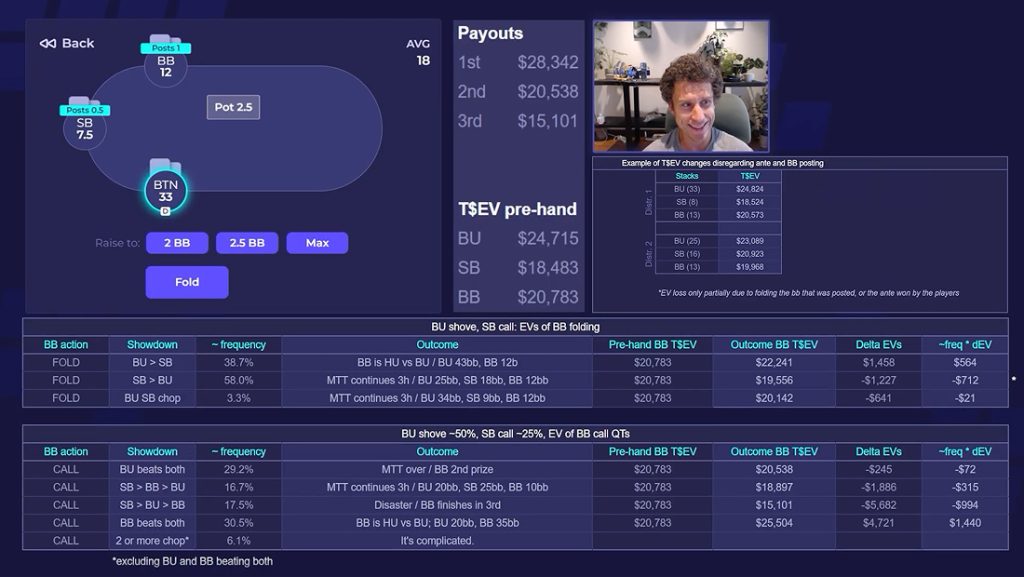
Facing a shove and a call, you call off 2.5x wider as a range than against the shove alone, and in extreme spots up to 10x wider. Daniel kills the freeroll fallacy with the spreadsheet math and the sims to prove it.
Calling Wider as the Third Player In - 1 Video
In some cases, you should call wider when facing a shove and a call than against a single shove. Learn why this happens, when to apply it, and how to spot the right situations to take advantage of this adjustment.
FAQ
I already have a 26-day training plan, is this next?
If you’ve finished the 26-Day Plan and you’re running deep in MTTs but not closing, yes. Tournament Savagery picks up where foundational training stops: ICM mechanics, population exploits, and the final-table spots that decide who wins.
What’s the difference between 26-day training plan and Tournament Savagery?
The 26-Day Plan builds the foundation. Tournament Savagery assumes you have one. Nick and Daniel don’t explain what ICM is; they show you how to price bubble factors into real decisions, exploit the gaps between GTO and how fields actually play, and close out final tables.
I already study with solvers. What does this add?
The layer charts can’t give you. Every lesson pairs the equilibrium with node locks showing what real fields do instead, and how to price that gap into your decisions. Daniel’s framing: figure out what equilibrium looks like, then work out which side of it your opponent sits on and adjust.
How do the drills work?
Select videos carry a direct link that loads that exact spot in the range trainer with the settings already prepared. You watch the concept, then you run the spot until the play is automatic. Your included month of GTO Lab Pro unlocks the trainer.
What does the included month of GTO LAB Pro cover?
Full access to the preflop ICM & GTO trainer, the 130+ hour MTT coaching video library, and the chip EV postflop GTO library. If you already subscribe to Tools or Pro, we add the free month to your current subscription within 24 hours; send your details to support@gtolab.com.
Who is the masterclass Tournament Savagery for?
Serious tournament players. Mid-stakes grinders get the most complete map of when ICM matters, when it doesn’t, and how to exploit the population at each stage. High-stakes pros get the nuances: stack distributions, FGS, and the spots where population tendencies open the door to non-intuitive exploits. Nothing is dumbed down.
Nick and Daniel built it as a mix of concepts, solver work, and real hand reviews with back-and-forth between the two of them, so 25 hours of it stays watchable. If you’re new to tournament poker, start with the 26-Day Training Plan.
How long do I have access to the course?
You will have lifetime access to the Tournament Savagery Masterclass once purchased. While for the practice links you need an active Tools or PRO subscription.
What payment methods are accepted?
We accept major credit and debit cards, and other payment methods, depending on your country. If you wish to use Luxon Pay or need an alternative option, please contact us, and we will do our best to accommodate your request.
Is the content available for download?
No, the videos are streaming-only to protect course integrity.
Do I need any special software to view the course?
No. The course is hosted on our platform and can be accessed through any modern browser.
Can I watch the course at my own pace?
Yes. The course is entirely self-paced, allowing you to study at your convenience. You can pause, rewind, and rewatch any section as many times as needed.
Are there subtitles or translations available for Tournament Savagery?
Tournament Savagery currently comes with subtitles in 10 languages: English, Spanish, French, Simplified Chinese, Korean, Japanese, Vietnamese, Portuguese, Italian, and Russian.
Who do I contact if I have technical issues?
If you experience any issues with payment, login, or streaming, please contact our support team via email: support@gtolab.com
WANT TO KNOW MORE? BOOK A DEMO CALL
If you’re curious or want a demo or sneak peek, you are welcome to book a demo session with us. We will give you an overview and answer any questions you might have. But hurry up, spots are limited!
STILL IN DOUBT? GET IN TOUCH!
READY TO BECOME A TOP MTT PRO?
Every stage. Every stack size. The solver baseline and the human deviations that pay for it.
Learn ICM from Nick Petrangelo and Daniel Dvoress, then drill it until it’s automatic.